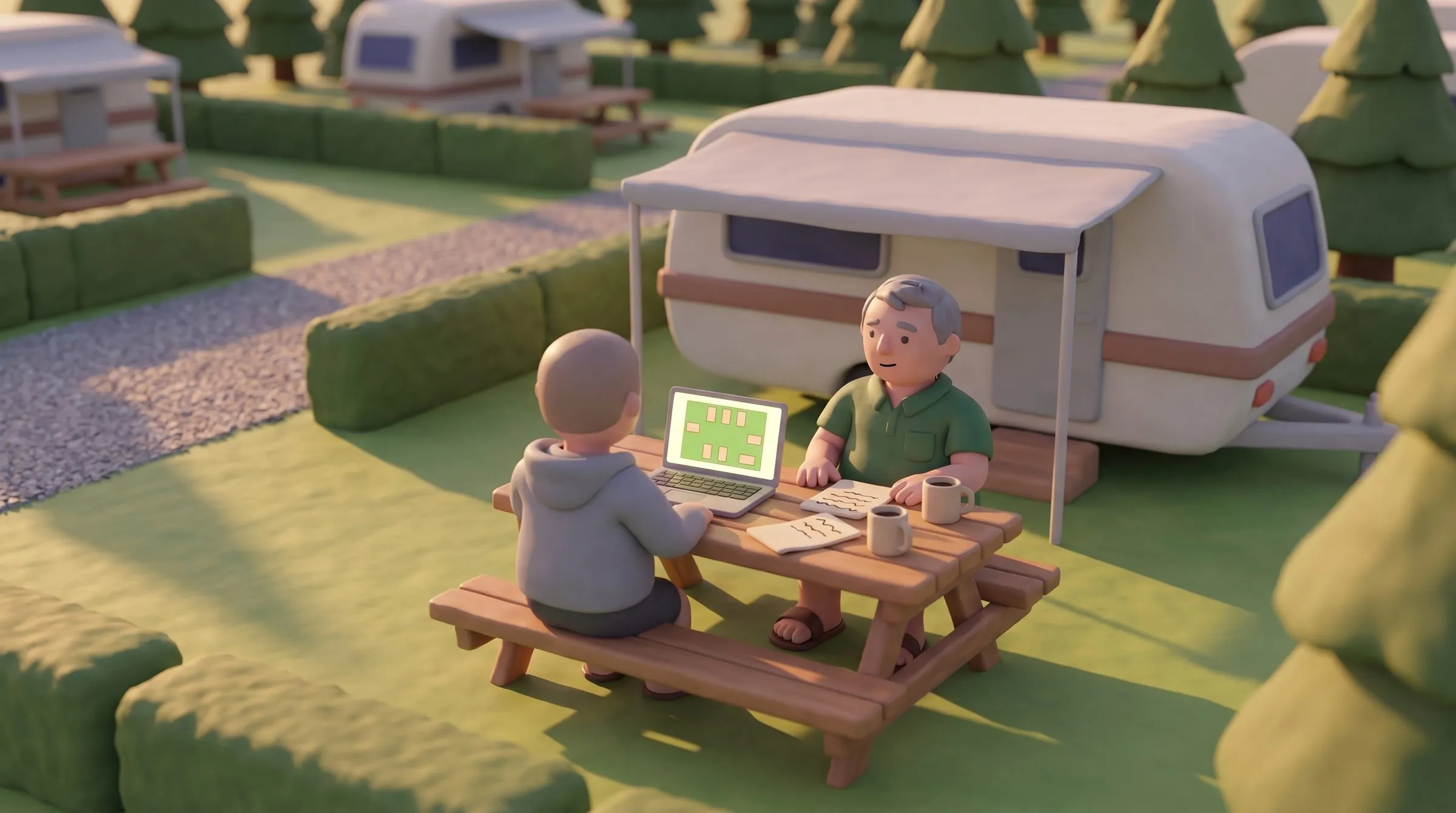
Why I’m building campsite software
I’m Hape, and I’m a seasonal camper myself. Our caravan has a long-term pitch on a site near Thedinghausen in Lower Saxony, Germany, and like many sites, ours ran on a spreadsheet for years. The reason I now build campsite software has a lot to do with that site, with a friend who put an idea in my head, and with a rather naive schedule.
In 30 seconds:
- CampsiteHero is campsite management software from Germany. It started in 2026 on a site near Thedinghausen in Lower Saxony.
- The trigger: the site’s booking software was discontinued on 28 February 2026, just before the season.
- Built with the help of AI, kept in check by the same rules a development team uses: tests that must keep passing and fixed coding standards.
- The motto: make the people affected the people involved. Beta sites have a say in what gets built next.
From spreadsheet to online booking – and back
I had helped our site set up online booking software. The idea was simple: guests book online instead of calling. It’s more convenient for guests, and the owner saves time because not every booking has to be copied into the spreadsheet by hand.
Just as everything was running reasonably smoothly, the news arrived: the provider, CloudCamping, was shutting its software down on 28 February 2026. For a site whose season starts in spring, that’s not a good moment. Suddenly the question was: now what?
An idea I couldn’t shake
That question came at a time when I was asking myself one too: where do I actually want to go from here? I’ve been programming for twenty-five years. Most recently I digitised processes at a mid-sized company, a warehouse for example. I enjoyed that work. At the same time, I wanted to put my energy into something of my own, something I’m responsible for from start to finish.
Then a friend told me how he took a chance as a student, despite the money and the risk involved. At some point he said: “This is your chance. You know campsites, and your site owner needs a solution right now. Ask him to get involved. In return, he gets new software.”
So I wrote a concept and pitched it to our site owner. He said yes.
Three months. Or so I thought.
My plan sounded manageable: take bookings, place pitches on a map, send invoices. A first prototype, a so-called MVP (minimum viable product), would be ready in three months so the site could use it that season. That was in February. Our season starts in April.
Today I know everything that comes with it: data protection, record-keeping rules, sequential invoice numbers, secure data transfer and a lot more. Any site owner who has dealt with this knows what I mean. Honestly, it’s a good thing I didn’t know all that back then. Otherwise CampsiteHero might not exist today. I’ll write about those stages in future posts.
I had one advantage from day one: I knew daily life on the site up close, as a seasonal camper and as the person who had set up the online booking. I knew what helps the owner day to day and what he was missing. On top of that came market research and plenty of concept pages before the first line of code was written.
The bet on AI
Software that manages bookings needs more than the program itself: servers, firewalls, backups, all the infrastructure behind it. Web development is my craft. Servers and infrastructure weren’t, back then – I had to learn them. That’s where a question came in that many people have mixed feelings about: what can artificial intelligence actually do?
Before committing, I tried it out. In a three-day hackathon I built a small web application with AI assistants such as Claude and ChatGPT, including a server, interfaces, a front end and business logic. The result surprised me. The AI was fast and genuinely good in many places, and for a moment I thought: that’s my job gone.
After a few long conversations with friends, I raised the stakes: I’d build CampsiteHero not against AI, but with it. It wasn’t easy. The AI makes mistakes, and there were moments when I talked to my screen rather loudly. The answer was the same as in any good development team: clear rules.
- Test first, then code. Before a feature is built, a test describes how it should behave. Every later change has to pass that test, so we notice straight away if something that used to work breaks.
- Fixed coding standards. How code looks and is structured is written down in a guide, and the AI has to follow it just like a person on the team.
The AI is my tool. The responsibility is mine. And our servers now run in a data centre in Nuremberg, Germany, with hourly backups.
Make the people affected the people involved
Of course I dream of CampsiteHero becoming something big. You need a vision. But the goal was different from the start: our site owner should get software that takes work off his hands and that he enjoys using.
My motto for that is: make the people affected the people involved. Whoever has to work with a piece of software should have a say in it. That’s why we agreed on a principle in our very first conversation: if it isn’t clear whether option A or B is better for the site owner, we build in a switch. Then you decide, not us. That doesn’t work everywhere. Sometimes both options don’t fit into the software, and sometimes the law decides. But in many places it works, and that beats “take it or leave it”.
That’s also why openness matters to me. I want to hear what’s good about CampsiteHero and what isn’t, so I can improve it. Sites that join the beta now have a say in what gets built next.
Where we are today
Now, in September 2026, we’ve reached a point I’m proud of. For touring guests, a lot is already in place. Ironically, seasonal campers – people like me – aren’t supported yet.
I’m looking forward to showing CampsiteHero to other sites now. I’m curious, and I have a healthy respect for it. And the three months from my first plan? Goodness, was I naive.
Get involved: if you run a campsite and want a say, save your place in the beta.
Frequently asked questions
Who is behind CampsiteHero?
Hape, a developer with twenty-five years of experience who is a seasonal camper himself, and a campsite near Thedinghausen that has helped shape the software from the start.
Why does CampsiteHero exist?
Because our site’s booking software was discontinued in early 2026, and I wanted to build software that genuinely takes work off site owners’ hands.
Is CampsiteHero developed with AI?
Yes, with the help of AI. The same rules apply as in a development team: tests make sure features behave as described, and the code follows fixed standards. The responsibility is mine.
Does CampsiteHero support seasonal campers?
Not yet. For touring guests, a lot is already in place.
Can I have a say in what comes next?
Yes. Sites in the beta have a say in what gets built next.