
Running a campsite: where the time goes
When I started building CampsiteHero, the goal was simple: the owner of our site, where I’m a seasonal camper myself, should get software that fits his site as quickly as possible. The smallest possible prototype, ready in three months. Since February 2026 it has become a good deal more than that. The software is in alpha testing on our site, and it now runs very well. Along the way we learned where site owners really lose time in the office.
In 30 seconds:
- CampsiteHero is campsite management software from Germany, developed together with a site near Thedinghausen that uses it in alpha testing.
- The biggest time sinks in the office: enquiries by email and phone, cancellations, language barriers, occupancy in a spreadsheet, getting invoices into the accounts, and monthly statistics reports.
- Our principle: the site owner sets everything up himself, from the age limit for teenagers to the cancellation scale.
- The start of a series: each of these points gets its own post.
“Can you just program that in for me?”
It started with a question: what does a prototype need to do at the very least to be useful? Create pitches, pitch categories, prices, guest categories such as adults, children and teenagers. The longer we thought about it, the clearer it became that hardly any of it can be fixed in advance. Even the question of what counts as a teenager on your site has a different answer on every site. How old at least, how old at most?
So we decided early on: the site owner sets it up himself, the way he needs it. Without having to call me and ask: “Can you just program that in for me?” That was the first lesson. The second came once the basic concept was written down: where does it actually hurt site owners the most?
Pain point 1: enquiries everyone writes differently

Paperwork, spreadsheets, website forms that arrive as emails, and emails from guests who word their enquiry however it occurs to them. All of it has to be read, copied over and often followed up: would a different pitch work? A different day? Sorry, we’re full.
The biggest pain behind it sounds odd at first: guests can’t organise themselves. Yet the guest knows exactly when they want to come, with which vehicle and with how many people. If they enter that into a system themselves instead of the owner typing it up, it lands cleanly and consistently in a database. That saves time, and the error rate drops considerably.
Pain point 2: language barriers
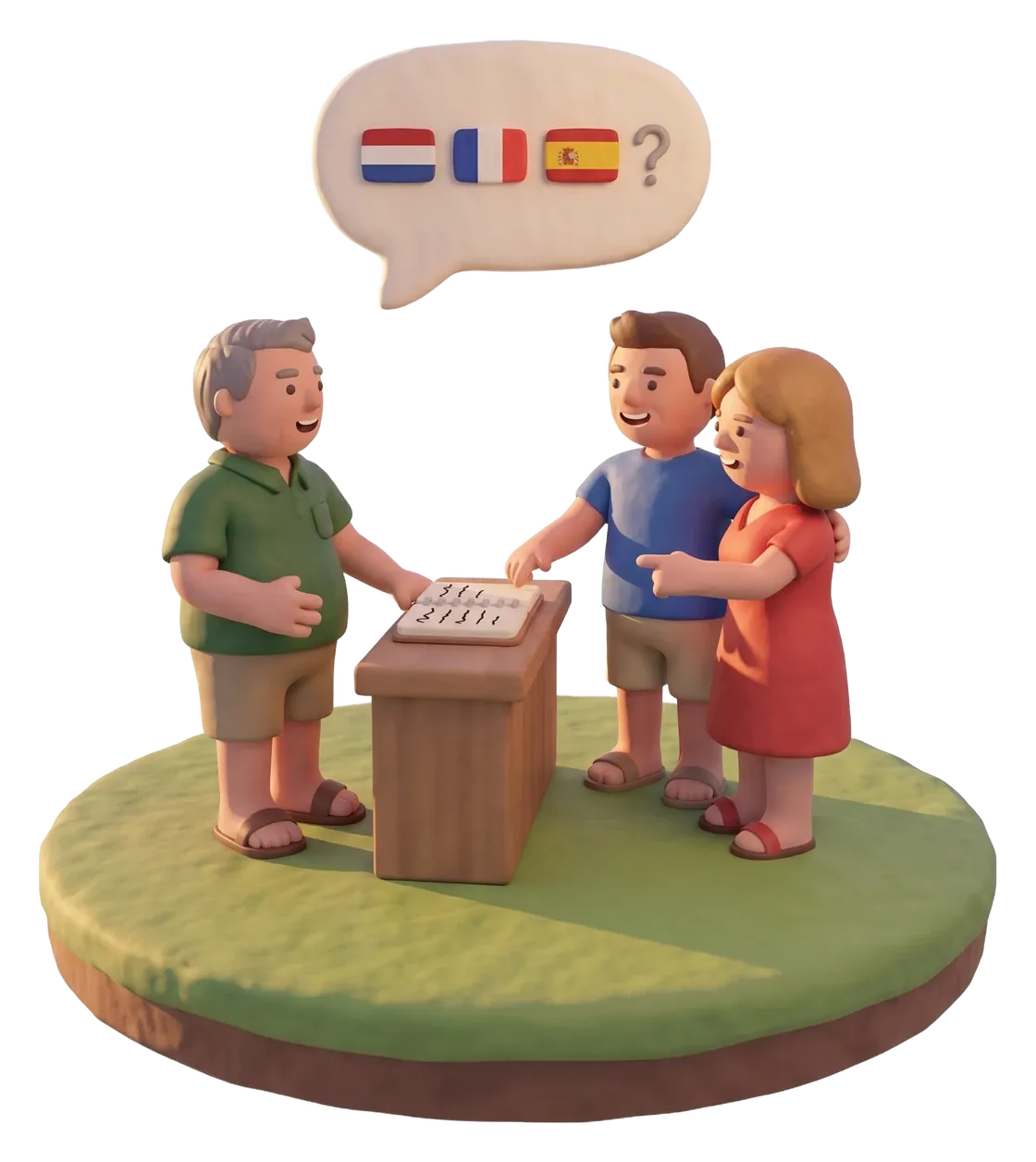
It gets particularly interesting when the enquiry comes in Dutch, or in shaky German, by email or on the phone. Of course you could learn Dutch, then French and Spanish, and then it’s no problem at all. But not everyone can.
On a campsite everyone is on first-name terms, and with hands and feet it somehow works. But it costs time, at the barrier during check-in just as much as in the office where the booking is entered. Guests who book online themselves don’t need that translation work. That’s why CampsiteHero’s booking pages are available in 20 languages.
Pain point 3: cancellations

Bookings get cancelled because people fall ill, change their plans or want to come a week later. One of our site owner’s first wishes was: can guests cancel themselves via a link in their email? They can.
There’s a second issue behind it. Our site owner was often very accommodating. Anyone who at least called to say they couldn’t make it at short notice, on the day of arrival itself, could count on his goodwill. It was harder when someone had reserved by phone or email and simply didn’t turn up. Do you chase them? Charge a cancellation fee? Maybe even bring in a debt collector?
The hotel industry sorted this out long ago: flexible rates that cost a little more, or scales such as “free up to 30 days before arrival, 50% up to 10 days, 90% up to 1 day before”. We left this to the site owner as well. He decides whether he wants a cancellation policy at all and how finely it is graded. If a guest then cancels three days before arrival and the policy says 50% up to ten days before, the invoice is created automatically and sent by email.
That’s fairer for the guest too. They saw and accepted the terms when booking, instead of having them explained on the phone or pasted into an email. Both sides know where they stand. And an owner who wants to be accommodating can of course still cancel the invoice. What happens if someone doesn’t pay at all is up to each owner.
Pain point 4: the map that weighed 70 megabytes

Many sites have a drawn site plan in clip-art style: pitches, toilet block, playground, a legend. Ours ended up at 60 to 70 megabytes. Loading something like that on a phone makes no sense. Shrinking and compressing only helps until you can no longer make anything out. Today CampsiteHero lays your own site plan over the map as tiles, the way map services do: only the section the guest is looking at gets loaded. Each pitch can also have photos, a description and details.
Our site warden would have loved drone flights and 360-degree photos straight away. And then we got carried away: a little sat-nav from the barrier to the pitch, a guide to how the caravan may be positioned, measuring pitches by GPS and charging by the square metre. None of it is planned. But you really do start dreaming about how much could be digitised.
I know from another site owner what must not get lost along the way: human contact. At check-in you get to know each other, pass on a few words and get a feel for the guest. And when it gets busy, you need to be able to re-plan at the desk on the spot. Software has to allow that, not prevent it.
Pain point 5: the spreadsheet three people are editing at once

Our site owner worked with spreadsheets for a long time. Anyone wanting to allocate a pitch scrolls endlessly to see whether it’s free. With practice it works, but it costs time every time. It gets really difficult when several people work on the list at once: someone calls the office, a guest at reception wants to book for next week, and an email comes in at the same time. Shared editing is possible these days, but people still get in each other’s way. And it takes setting up and practice, time that is missing in the season.
Then there’s the phone call you keep in your head and only enter half an hour later. By then it may be too late. In CampsiteHero’s occupancy plan everyone sees the same picture, and online bookings show up in it straight away.
Pain point 6: invoices that still have to reach the accountant

Creating an invoice is only half the job. It also has to go into the accounts. Our site owner uses DATEV, the accounting system common among tax advisers in Germany, and no longer wanted to download every invoice, upload it to DATEV and assign it there. Today there are two ways: the DATEV export of booking batches, or sending invoices to DATEV automatically by email. Invoices are also available as e-invoices in the ZUGFeRD format, which DATEV can read directly.
The DATEV connection is new. We learn with every tax office we work with and welcome any feedback.
Pain point 7: the mosquito at the end of the month

Freshly on my list: the monthly report for Germany’s accommodation statistics. German campsites with at least ten pitches report to their state statistical office every month how many guests arrived, how many nights they stayed and where they come from. Our site owner used to go through invoices at the end of each month to work out who had come from which country. That takes one, two, maybe three hours a month. Above all, it’s annoying, like a mosquito that keeps biting. On top of that come the registration forms for guests from abroad, a separate obligation I’ll write about on its own in this series.
The accommodation statistics report is listed on our website as “coming soon”: the report is to be generated directly from the bookings. Then that’s one less thing. (As of September 2026. What your state statistical office requires is binding.)
Finishing an hour earlier
There’s a huge amount to do on a campsite, and office work is usually the most tiresome part. It keeps you from things that may matter more. And in the season, which runs from spring to autumn on most sites I know, long days are perfectly normal. I’m building CampsiteHero so that the people who use it have less stress. Even if it just means finishing an hour earlier in the evening and enjoying the day.
With more sites we’ll certainly discover things we haven’t thought of yet. That’s exactly what the beta is for. In the next posts I’ll take each of these pain points in turn: what’s behind it, what it costs, what the rules are and how we solved it.
Over to you: what costs you the most nerves in the office? Not your back, the admin. Where would you say: if that happened automatically, I’d have far less stress? Tell us.
Frequently asked questions
Which office work costs campsite owners the most time?
In our experience: enquiries by email and phone, cancellations, language barriers, keeping track of occupancy in a spreadsheet, getting invoices into the accounts, and monthly reports such as the accommodation statistics in Germany.
Can I set my own age limits for children and teenagers?
Yes. In CampsiteHero you create your own guest categories, each with its own age range.
Can guests cancel their booking themselves?
Yes, via the link in their booking email. The fee follows your cancellation scale, and the invoice is created automatically.
Does CampsiteHero pass invoices to DATEV?
Yes, as a DATEV export or by email directly to DATEV. Invoices are also available as e-invoices in the ZUGFeRD format.
Does CampsiteHero handle the accommodation statistics report?
Not yet. The feature has been announced.